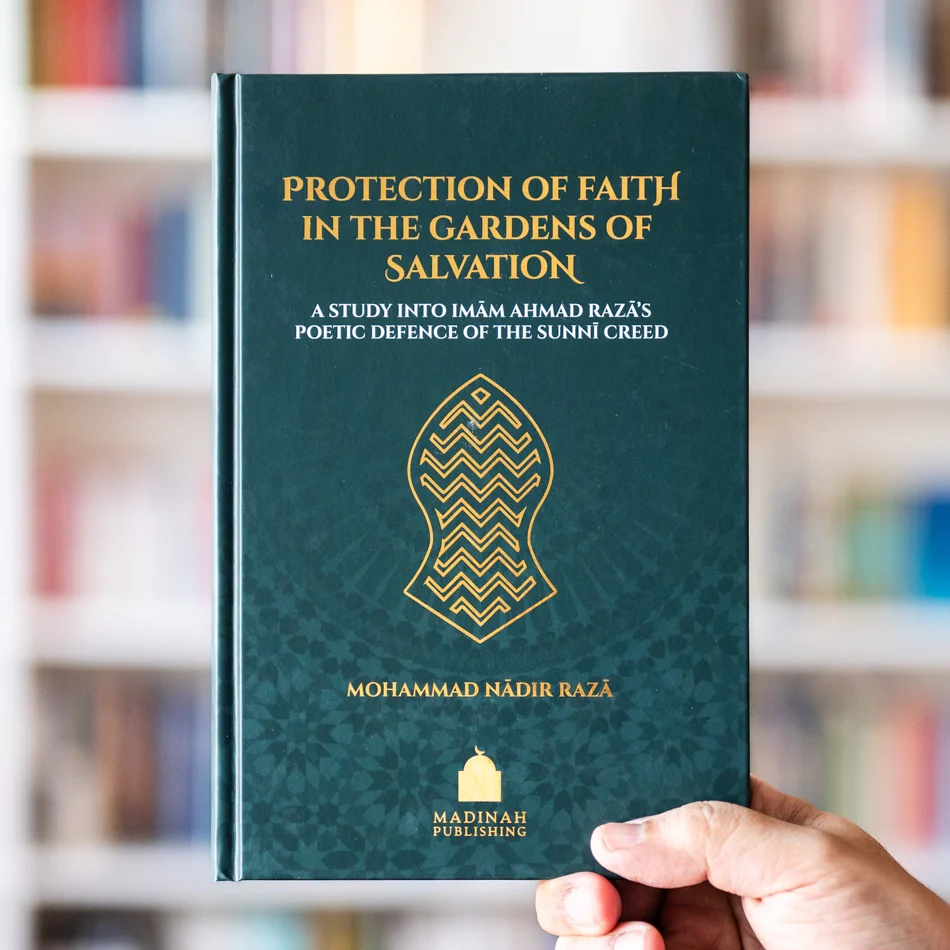
Protection of Faith in the Gardens of Salvation
Mohammad Nadir Raza
Hardback, 202 pages
9781399903486
A Study into Imam Ahmad Raza’s Poetic Defence of the Sunni Creed
Imam Ahmad Raza Khan Qadiri (1856-1921 CE) of Bareilly, fondly referred to as Ala Hazrat (Grand Master) by his devotees, was a Mufti (Islamic jurist), Alim (scholar), Sufi (mystic), Sha'ir (poet) and master of many other disciplines who emerged as a central figure for the Ahl-e-Sunnat movement during British India. He played a pioneering role in countering the theological beliefs of other movements that emerged in this period from amongst the Muslims of India, including the Ahl-e-Hadith, Deobandi and Qadiyani movements. It is for this reason that he was regarded by his devotees as a mujaddid - a reviver of Islam that emerges each century to purify the religion back to its most pristine state and preserve the religion against heresies.
In western academia, Imam Ahmad Raza's historical significance has previously been explored scarcely and been limited to biographical accounts and references to a handful of his books and fatāwa (legal verdicts). A focus on his role as a poet is almost non-existent. Imam Ahmad Raza's devotional poetry, found in the collection Hadäig-e-Bakhshish (Gardens of Salvation), was an instrumental tool in launching his theological defence and disseminating what he considered as the true beliefs of Islām.
This is the first study that focusses on Imam Ahmad Raza's significance as a poet, the theological concepts found in his poetry and the role it played in defending against opposition from other religious movements in British India. It attempts to answer the question: What role did Imam Ahmad Raza's poetry play in a period where the Ahl-e-Sunnat's theological beliefs were challenged by other reform movements in British India?
Original: $28.10
-70%$28.10
$8.43Product Information
Product Information
Shipping & Returns
Shipping & Returns
Description
Mohammad Nadir Raza
Hardback, 202 pages
9781399903486
A Study into Imam Ahmad Raza’s Poetic Defence of the Sunni Creed
Imam Ahmad Raza Khan Qadiri (1856-1921 CE) of Bareilly, fondly referred to as Ala Hazrat (Grand Master) by his devotees, was a Mufti (Islamic jurist), Alim (scholar), Sufi (mystic), Sha'ir (poet) and master of many other disciplines who emerged as a central figure for the Ahl-e-Sunnat movement during British India. He played a pioneering role in countering the theological beliefs of other movements that emerged in this period from amongst the Muslims of India, including the Ahl-e-Hadith, Deobandi and Qadiyani movements. It is for this reason that he was regarded by his devotees as a mujaddid - a reviver of Islam that emerges each century to purify the religion back to its most pristine state and preserve the religion against heresies.
In western academia, Imam Ahmad Raza's historical significance has previously been explored scarcely and been limited to biographical accounts and references to a handful of his books and fatāwa (legal verdicts). A focus on his role as a poet is almost non-existent. Imam Ahmad Raza's devotional poetry, found in the collection Hadäig-e-Bakhshish (Gardens of Salvation), was an instrumental tool in launching his theological defence and disseminating what he considered as the true beliefs of Islām.
This is the first study that focusses on Imam Ahmad Raza's significance as a poet, the theological concepts found in his poetry and the role it played in defending against opposition from other religious movements in British India. It attempts to answer the question: What role did Imam Ahmad Raza's poetry play in a period where the Ahl-e-Sunnat's theological beliefs were challenged by other reform movements in British India?